
Designing Effective Common Mode Filters for Noise Suppression
Designing effective common mode filters—specifically common mode chokes (CMCs)—for noise suppression is all about targeting unwanted common mode (CM) noise while letting the desired differential mode (DM) signal pass unscathed. These filters are critical in RF, power, and high-speed digital systems where EMI/RFI can wreak havoc. Below, I’ll walk through the design process, key considerations, and practical tips, keeping it actionable and rooted in real engineering.
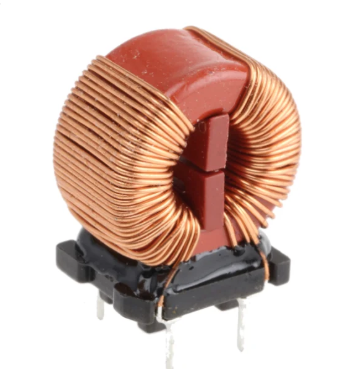
Design Principles for Effective CMCs
Understand the Noise
Goal: Identify the frequency, amplitude, and source of CM noise (e.g., 60 Hz from power lines, 100 MHz from RFI).
How: Use a spectrum analyzer or scope with a CM probe to measure noise on both lines.
Why: The choke’s impedance must peak at the noise frequency—miss the target, and it’s useless.
Select Core Material
Mn-Zn Ferrite: High permeability (µ = 2000-5000), great for low frequencies (kHz to 10 MHz), like power line noise.
Ni-Zn Ferrite: Lower permeability (µ = 100-1000), higher frequency range (10 MHz to 1 GHz), ideal for RF.
Powdered Iron: High saturation, lower µ, for high-current apps (e.g., 10 A).
Options:
Choice: Match material to noise frequency—e.g., Ni-Zn for 100 MHz EMI in a USB line.
Trade-Off: High-µ cores saturate faster; low-µ cores handle more current but offer less impedance.
Determine Inductance
Calculate LLL needed: Ztarget/(2πf)Z_{ ext{target}} / (2pi f)Ztarget/(2πf).
Example: For 1 kΩ at 100 MHz, L=1000/(2π⋅100⋅106)≈1.6 μHL = 1000 / (2pi cdot 100 cdot 10^6) approx 1.6 , mu ext{H}L=1000/(2π⋅100⋅106)≈1.6μH.
Increase turns (L∝N2L propto N^2L∝N2) on the core to hit this.
Goal: High CM impedance (Z=2πfLZ = 2pi f LZ=2πfL) at the noise frequency.
How:
Trade-Off: More turns boost LLL but add parasitic capacitance, rolling off high-frequency performance.
Minimize Differential Mode Impact
Leakage inductance (non-cancelled flux) should be <1% of CM inductance.
Goal: Near-zero impedance for DM signals (opposite currents).
How: Wind coils bifilar (side-by-side) or twisted to maximize flux cancellation.
Test: Measure DM insertion loss—aim for <0.1 dB.
Trade-Off: Tight winding improves DM but can increase inter-winding capacitance.
Handle Current Without Saturation
Check core’s BsatB_{ ext{sat}}Bsat (e.g., 0.4 T for ferrite).
Use B=μHI/lB = mu H I / lB=μHI/l (where H=NI/lH = N I / lH=NI/l, lll = magnetic path length).
Example: 1 A, 10 turns, 10 cm core → pick a core with enough cross-section (A) to keep B<BsatB < B_{ ext{sat}}B<Bsat.
Goal: Core must not saturate under max DM or CM current.
How:
Option: Gapped cores or larger toroids for high-current apps (e.g., 20 A power lines).
Trade-Off: Bigger cores = more cost and size.
Optimize Frequency Response
Single choke for narrowband (e.g., 50 kHz switching noise).
Multi-stage (two chokes, different LLL) for broadband (e.g., 10 kHz to 100 MHz).
Add shunt capacitors post-choke to ground residual CM noise (forms a CM LC filter).
Goal: High CM attenuation (20-40 dB) across the noise band.
How:
Limit: Parasitic capacitance creates a resonance peak (e.g., 200 MHz), above which attenuation drops.
Practical Construction
Winding: Equal turns on both lines (e.g., 10 turns each), symmetrical placement on toroid or E-core.
PCB Layout: Keep input/output traces short to avoid noise pickup post-choke.
Shielding: Enclose in a metal case if near strong EMI sources (e.g., motors).
Test: Sweep with a network analyzer for CM impedance and attenuation.
Key Design Steps
Define Specs: Noise freq (e.g., 100 MHz), current (1 A), attenuation (30 dB), DM signal (e.g., 1 GHz data).
Pick Core: Ni-Zn toroid for 100 MHz, sized for 1 A without saturation.
Calc Turns: 1.6 µH for 1 kΩ at 100 MHz → ~5-10 turns depending on core ALA_LAL.
Simulate: Use SPICE or RF tools to model CM/DM response.
Build & Test: Measure CM rejection with a VNA or EMI receiver.
Real-World Applications
USB 3.0: A 600 Ω (at 100 MHz) CMC kills RF noise from nearby Wi-Fi, preserving 5 Gbps data.
Switching Power Supply: A 10 mH Mn-Zn choke on a 12 V line cuts 100 kHz CM noise by 40 dB.
Ethernet: A 120 Ω choke at 10 MHz stops CM interference from power cables, keeping packets clean.
RF Receiver: A GHz-rated CMC on a bias line blocks 50 MHz spurs from a local oscillator.
Practical Tips
Overkill Warning: A massive choke for 10 MHz noise wastes space—match the design to the problem.
Capacitor Pairing: Add 100 pF caps to ground after the choke for extra high-freq punch, but watch for DM signal distortion.
Saturation Check: Test under worst-case current—saturation turns it into a wire.
Cheap Wins: A $1 ferrite bead often beats a $10 custom choke for simple RF fixes.
The industry might push boutique multi-stage filters, but a single, well-sized CMC often nails it—don’t fall for the upsell unless broadband noise demands it.
Email us
Warning: Undefined variable $pronamepx in D:\wwwroot\www.resistorsupplies.com\moban\en_inc\ziliao.php on line 67
Fatal error: Uncaught TypeError: count(): Argument #1 ($value) must be of type Countable|array, null given in D:\wwwroot\www.resistorsupplies.com\moban\en_inc\ziliao.php:67 Stack trace: #0 D:\wwwroot\www.resistorsupplies.com\ziliao.php(146): include() #1 {main} thrown in D:\wwwroot\www.resistorsupplies.com\moban\en_inc\ziliao.php on line 67